Support Life And Music
D.R.E.A.M.
Data, Research, Education, Awareness, and Music
VI.
Words and Music
This D.R.E.A.M. Report made possible through a generous grant by the Arizona Eastern Star Foundation. For more information about the Arizona Eastern Star Foundation, please visit https://www.azoes.org/az-oes-foundation.html
♫
So let it be written.
Every song tells a story. Music’s most celebrated lyricists have made careers of pairing words with music to paint pictures, tell tales, and evoke moods. It’s no surprise that so many of our SLAM: Music Survival Guide guests have called out the act of writing as therapeutic, as a way of coping. This D.R.E.A.M. report is focused on the connections between the written word and mental health, as expressed by SLAM Summit participants.
I guess it’s obvious I also like to write.
This topic is kind of a doozy, so we’ll need to make some clarifications:
We’re mainly focused on the personal act of writing (journals, diaries, poems, lyrics, stories, memories, half a page of scribbled lines, etc.) as a therapeutic exercise – – not necessarily professional writing or writing to fulfill assignments. Let’s all agree, though, that therapeutic comfort can also be found writing for the latter purposes as well. A few judgment calls were made determining the relevance and qualification of inclusion of some of the quotes in the dataset.
This particular study makes no distinction between writing by hand or typing on a keyboard.
The Findings:
People said I was a writing fool.
After researching and parsing the relevant commentary, we broke down the top writing-related themes into the following five categories: Emotional Processing, Self-expression, Pure creativity, Recording personal history, Self-identity.
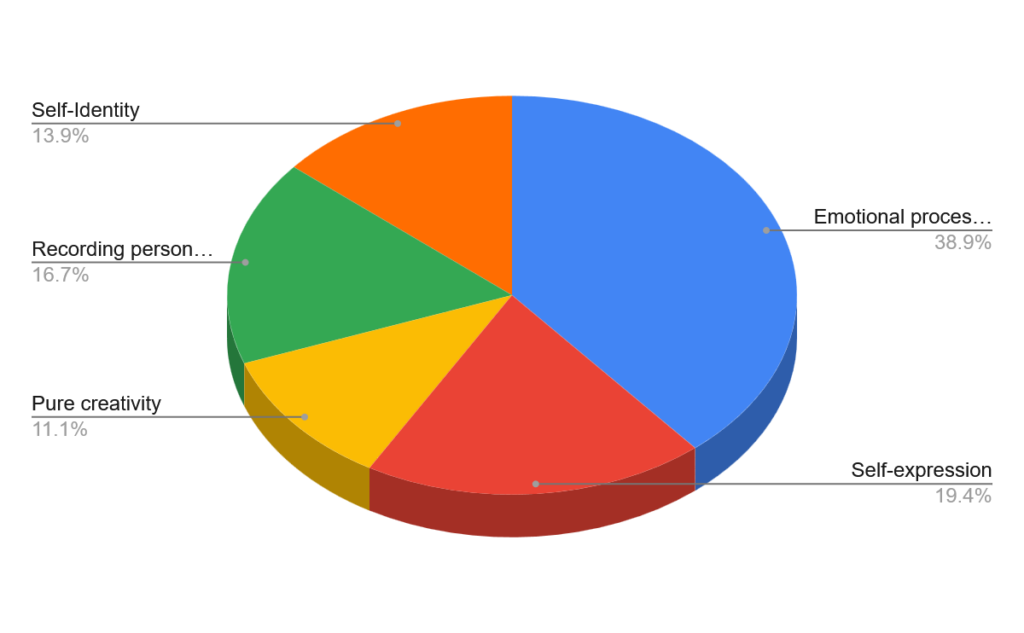
Emotional processing: The act of writing out thoughts and feelings in order to better process, understand, and cope with situations, thoughts, feelings, or anything else in one’s environment.
“I guess that’s a way that you can express that instead of holding it all inside you, I did some incredible writing, just trying to work through the stuff that was in my head and in my heart.”
“That’s my therapy, really. . . And it’s far cheaper than paying 300 bucks an hour to see a therapist. I get to process all my emotions. Write it down.”
“You could just write about it. Just write a letter. You don’t have to write a poem. You could write a letter, you could just write adjectives, whatever you want. But. . . release the steam valve.”
Self-expression: The need to channel strong or profound feelings or thoughts via the written word – – for the sake of the feeling, not for art’s sake.
“it doesn’t matter if you’re a writer or a musician. You put yourself into your book quite a lot, especially if it’s your first one.”
“I wrote this because it needed to come out.”
Pure creativity: Similar to Self-expression, Pure creativity focuses on the artists’ universal urge to channel their words and their expression into a work of art.
“Sometimes I’ll grab from the mountains of little slips of pieces of paper that I have everywhere with phrases and words and paragraphs and partial lyric ideas, or…notebooks I have, and things like that.”
“Most of the time, when people fall into the dark places, there’s a part of their being, whether it’s an artistic or creative side of them, that’s screaming to get out.“
“I read all the time, I write all the time, I’m always writing, I’m always reading.”
Recording personal history: Journaling, diary writing, recording events, thought, feelings, etc. so they’re not forgotten.
“Hey, you were there. You saw this. We think you know you should write about it and share it.”
“Everything that you do as a musician or a writer. You’re putting it out there.”
“There were moments that weren’t amazing, and they were kind of dark, but I thought: All of that has to be in there “
Self-Identity: Writing out words as an exercise to help deepen understanding of one’s self and one’s own motivations.
“Everybody has a story. You just have to find it.”
“ A great exercise is to just draw a line down the center of a blank sheet of paper and in the left column, write all the things that you don’t want. And then on the right side, just write the complete opposite. Cut the paper in half. Throw the left side away. And now you have the things that you want.”
If someone could write the feelings of the heartaches and the pain.
Conclusion: We’ll state the obvious first: writing is favorably viewed by SLAM Music Survival Guide guests as a therapeutic exercise. Varying commentaries on the purposes and specific benefits were found, as described above, but there were no disparaging remarks for the act of writing. Unsurprisingly.
There was one surprising observation in our findings, however: Writing was never mentioned as an “escape,” in the same ways commonly ascribed to music listening, music performing, reading, acting, watching movies, exercise, gaming, and numerous other artistic, leisure, and/or wellness activities. Various panelists spoke of writing as a method for understanding, learning, coping, reflection, personal development, and even for confronting difficult feelings, but none spoke of writing as escapism.
In my personal opinion and experience, yes, many forms of writing can also provide healthy stress distractions. Do music professionals feel the same? We’ll dig deeper on this point for future iterations of this topic.
Recommendation: D.R.E.A.M. Reports typically don’t close with recommendations, but we’ll make an exception here.
Write.
Jot down your feelings, create poems, lyrics, narratives, stories, essays, memoirs, etc. Translate your ideas and feelings into words. Just always use proper grammar.
Every day I write the book.
♫
How it’s done done done.
- The S.L.A.M. internal Data Research Education Awareness Music Team (D.R.E.A.M. Team) analyzed the full spoken content of 50 different “SLAM: Music Survival Guide” panel discussion recordings, tagging meaningful statements across various categories. This report focuses on quotes associated with the concepts of success.
- We did not seek to confirm or debunk the truth or validity of any statements made. The purpose was to analyze, process, quantify, draw logical connections, find meaningful commonalities, themes, and/or contradictions between the statements, and ultimately share the recorded observations, feelings, concerns, beliefs, philosophies, etc., in the speakers’ own words and lyrics. No judgments of the speakers or others present on the call are intended, nor should any be inferred.
- The speakers were invited to participate in “SLAM Summit: Music Survival Guide” panel discussions. All episodes are publicly available or are scheduled for release at http://www.supportlifeandmusic.org/voices. The quotes in this report will be kept anonymous, and are not intended to be taken out of context as any kind of reflection on any persons involved in the conversations.
- Some of the content presented has been edited to:
- Remove extraneous words and phrases, like “you know,” “um,” “like,” etc., as well as to remove repeated or stammered words/phrases.
- Correct obvious Zoom transcription errors in translation, dictation, or grammar. (crosschecked against the actual episode audio.)
- No statement was changed, no quote was edited to directly or indirectly change its original meaning in any way.
- The “Conclusions” sections of this report were written solely in-house at Support Life And Music, and its recommendations are drawn from S.L.A.M. backgrounds in the music industry and mental health, as well as from the designated data set. All facts, figures, opinions, conclusions, and suggestions in this article are presented solely for informational purposes. There are mental health improvement techniques that can be undertaken by anyone in any situation to benefit themselves and others, but consultation with a certified mental health professional is always recommended. See the Support Life And Music website for an expansive list of healthcare providers.
References:
Metallica “Creeping Death” (1984). Ride the Lightning [Album]. Megaforce
Digital Underground “The Humpty Dance” (1990) Sex Packets [Album]. Tommy Boy, Warner Bros.
Pink Floyd “Time” (1973). The Dark Side of the Moon [Album]. Harvest, Capitol
Dan Baird “I Love you Period” (1992). Love Songs for the Hearing Impaired [Album]. Def American
Ray Charles “Somebody Ought to Write a Book About It” (1967). Here We Go Again / Somebody Ought to Write a Book About It [Single]. Abc Records, Tangerine Records
Elvis Costello “Every Day I Write the Book” (1983). Punch the Clock. F-Beat, Columbia.
Leave a Reply