Support Life And Music
D.R.E.A.M.
Data, Research, Education, Awareness, and Music
III.
Through the Mirror: Artist Commentary on Mirrors and the Need For Self-Reflection.
The following report has two sections: the first is a sampling of pop culture lyrics references, and the second draws from SLAM: Music Survival Guide transcripts.* Both are focused on artists’ commentary around the significance of self-reflection. In the latter section, no interpretations or usages of the terms have been excluded, whether the use was literal, metaphorical, or ambiguous.
Mirrors are a common recurring theme in religious texts and classic literature, including:
- Shakespeare’s “mirror crack’d” framing of the struggles of Hamlet and those around him.
- “Mirror, mirror on the wall,” from the seminal 1937 Disney film, “Snow White and the Seven Dwarfs,” became one of the most recognizable phrases of the 20th Century, and is often repurposed elsewhere in pop culture, especially in song lyrics.
- J.R.R. Tolkien and later J.K. Rowling – – along with numerous other creators – – have used magic mirrors to reflect other possible realities and futures.
- Lewis Carroll, Susannah Clarke, John Carpenter, and countless others have used mirrors as portals to other dimensions and places in their storytelling.
- Back in the real world, a mirror is a common platform for cutting and snorting lines of cocaine, one of the most well-known and destructive addictive drugs. This imagery is often found in stories and songs.
- The idiom, “smoke and mirrors” has gained traction since the 1970s, widely-credited to Jimmy Breslin’s use of it in describing the trickery around US President Richard Nixon’s Watergate scandal and impeachment proceedings. The phrase itself is a reference to the old-time magician’s method of using “smoke and mirrors” to fool their audiences.
- A mirrorball has become emblematic of dance clubs and music halls, hanging from the ceiling and scattering light reflections in numerous directions (Sarah McLachlan released a 1999 live album entitled “Mirrorball;” Neil Young collaborated with Pearl Jam on the 1995 record “Mirror Ball.” Pearl Jam then released a companion EP called “Merkin Ball.” Taylor Swift has a 2020 song titled “Mirrorball.”)
- Carnivals of the 19th, 20th, and 21st century often feature a “House of Mirrors” attraction, which are usually mazes of mirrored walls, intended to be disorienting. These are closely related to funhouse mirrors, which distort the reflection.
There is no way of tracking prehistoric use of water and ice as a reflective surface; the first human-created mirrors were made of obsidian in 6000 B.C. The ability to view one’s own reflection has been with us for millennia; it’s part of the human experience. Pop culture mirror references abound into infinity (unintended pun acknowledged).
Section 1. 20 Lyrical Mirror References.
Pop culture and musical references to mirrors are myriad and endless. We’ll present 20 here in the first section from diverse musical genres to show some of the far-reaching and arrayed uses* (25 more appear in a separate, bonus D.R.E.A.M. report):
- Queensryche’s (1988) concept album, “Operation: Mindcrime,” closes with the lead character staring into the “Eyes of a Stranger,” after his addiction has led him past redemption, acknowledging that “the mirror never lies.”
- Michael Jackson (1987) confronts the “Man in the Mirror,” not for his own sake, but to ask him to change his ways in order to make the world a better place.
- Like Michael Jackson, Live’s Ed Kowalcyk (1991) wants to do more good in the world in “The Mirror Song,” but he can’t seem to help himself, looking to “flags and mental jewelry” for definition.
- Jimi Hendrix (1971) could only see himself when he lived in a “Room Full of Mirrors,” but once he smashed them, the whole world was there for him to see. The mirror in this case enables selfishness and obstructs connection with others.
- With “Chop your breakfast on a mirror,” Metallica (1986) identify the mirror as a conveyance of self-destruction and the corruption of life norms. This lyric can be found in their anti-cocaine/addiction opus, “Master of Puppets.”
- Diana Ross invokes the Snow White reference in her (1981) hit, “Mirror, Mirror,” but not as an evil queen. In this song, she blames the mirror itself for misleading her and giving her false hope. The mirror also reflects aging. It “nails her heart to the wall” for its pleasure, while she remains trapped in it forever, watching herself get older.
- The face in the mirror “won’t stop” in one of Jim Morrison’s meditations on death for The Doors’ “When the Music’s Over” (1967).
- The mirror’s “gonna fog tonight” in Natalia Kills’ sexually-charged Pop smash, “Mirrors” (2011).
- In Def Leppard’s “Mirror, Mirror (Look Into My Eyes),” (1981) singer Joe Elliott struggles to believe it’s really him in the cracked mirror. Def Leppard are notorious for their Rock n’ Roll excesses. This song was co-written by guitarist Steve “Steamin’” Clark, whose life would end at 30, due to a lethal mixture of alcohol and prescription drugs.
- Def Leppard would return to the mirror imagery in their Billboard #1 heartbreak ballad, “Love Bites” (1987), in which the singer asks his ex-lover if she looks in the mirror when she makes love, and if her new lover looks like him. Again using the mirror as a vessel for insecurity and self-doubt.
- Lil Wayne’s song, “Mirrors (feat. Bruno Mars)” 2011 powerfully sets the scene of looking to the mirror for self-assurance, self-assessment, introspection, and self-reflection (literal and figurative).
- Bobby “Blitz” Ellsworth’s mirror “spits reflections of a lie” in Overkill’s take on self-deception in “Feed My Head.” (1993)
- Arcade Fire’s “Black Mirror” (2007) presents a cold, uncaring, apocalyptic image.
- Justin Timberlake uses mirror imagery seductively in his “Mirrors” song. (2013)
- The title track from Imagine Dragons’ “Smoke + Mirrors” (2015) references the singers’ disillusionment with organized religion.
- Huntrix, the fictional K-Pop girl-group of the animated KPop Demon Hunters movie, put a modern twist on the Snow White mirror with their swaggering bravado anthem, “How It’s Done” (2025). “Need to beat my face, make it cute and savage / Mirror, mirror on my phone, who’s the baddest? (Us, hello?)” Not an ounce of self-doubt here; this is full empowerment. They sing/rap this song while effortlessly dispatching demons.
- Steven Tyler of Aerosmith sings of seeing signs of getting older in his mirror in “Dream On” (1973). Aerosmith would later release an album entitled “Done With Mirrors” (1985), an intentional reference both to magician’s trickery and to cocaine use. This album was made and released while the band attempted a new beginning after years of heavy drug use, which had garnered Tyler and guitarist Joe Perry the nickname, “The Toxic Twins.”
- Like Aerosmith and Diana Ross, B.B. King also sees Father Time catching up with him in the song, “Why I Sing the Blues” (1969). “I look in the mirror everyday / And let it tell me the truth.”
- Blind Guardian’s fan-favorite, “Mirror, Mirror,” from their album, “Nightfall in Middle-Earth” (1998) uses Tolkien’s magic High Fantasy world as a setting for this scene of a leader’s struggle with the best decisions for the fate of themself, their friends, and the entire world.
- Rapper Kendrick Lamar uses a mirror to liberate himself from the pressures of others, suggesting that they view themselves in it, then turn it on him to reflect his freedom. “I choose me, I’m sorry.” This is for his fifth album’s outro track: “Mirror.” (2022)
♫
Conclusions for Section 1:
The examples and usages go on forever in popular music. The analysis provided here is based on this sampling of 20 songs,* as well as my personal professional music background. My own knowledge gaps and fallibilities must be acknowledged as factors. This is not an attempt to encompass all musics and all of the myriad uses of mirrors as metaphor and literal objects in songs.
The following common themes can be found in the song lyrics referenced above:
- Awareness of aging and mortality.
- Self-confrontation.
- Insecurity.
- Discomfort/dissatisfaction with the reflection.
- Drug use. Specifically cocaine.
- Mirror as symbolism.
- Reflections of others/society, often with defiance.
While mirror lyrics often refer to literal looking glass views, they are commonly used as metaphors for introspection, self-reflection, or reflection of others.
Section 2. SLAM: Music Survival Guide transcripts
Of the references listed in section 1, The Lil Wayne, Def Leppard, Diana Ross, Sigrid, Michael Jackson, and Live quotes hew closest to the relevant mirror-related messages and themes uncovered in the SLAM: Music Survival Guide episode transcripts. What follows is a list of organized quotes from these episodes. The nonattributed quotes are taken from pro musicians, music industry workers, and mental health professionals.
Keywords and phrases used:
“mirror”
“look at yourself”
“reflect”
“reflection”
“see yourself”
“Introspection” (zero results)
- I started to learn more about self and self responsibilities, taking accountability for your own actions within yourself. . . If you can sit in a room and look in a mirror, and you are. . . okay with what you see. . . sounds a little cliche, but it’s true.
- You have to meet you, and the best way to meet you is, go front of the mirror and speak to you. How can you say, “I love you?” And if you can’t say, “I love you,” but now you have to work on you. That’s the solution on my side.
- A lot of it comes down to the voices in your head, and so it comes down to you, developing these techniques of kinda not listening to those voices, or telling… turning the story around and telling a different story than maybe what those voices are telling you. And I don’t mean voices like you’re crazy, but you know what I’m saying. The things you think in your head, like, when you look in the mirror and you say, “Oh man, I look fat today,” or whatever. You know, maybe you look in the mirror and say, “You know, I don’t look so bad today.” It’s just a matter of changing that. And so there are little tools and things like that that you can do.
- We were looking at the extent to which the level of success you thought that you had impacted your level of well-being. Seeing that those who don’t view themselves as successful struggle with their mental health and well-being, like obviously so, and that forces you to then to have a conversation of, like, “What is success for you?” And I think, particularly as you get older, by which I mean you sort of care less about the opinions of others like, I’m 38 now, like I care much less about the opinions of others than I did when I was 21, or whatever. And what that means is you can then have a look at yourself, without judging yourself, like; what other things make you happy?
- Do you see yourself as successful? Yes, no, or don’t know. People that say “No” have worse mental health and well-being outcomes. So the question is: what does success mean to you? How do you define it?
- Personally for me, stepping away from a situation and being able to just reflect on trying, trying to reflect and. . . realize who I was, or who I’ve been my entire life, and just trying to embrace this person. But to step away and just really take a breather, and just to see everything, the big picture. . . It could take weeks. It could take months, but some it’s necessary, you know. . . As you said, it comes from within. You have to love yourself first, and if you can’t love yourself, you’re not going to love anything else. So you’re just going to be cynical and just a complete a-hole to most people. You just have to really come to terms with who you are. And if you’re comfortable with that, then you can be comfortable with moving on with your life.
- No matter where you are in the world. You’re feeling these things of sadness and loss and love and all that kind of stuff. And that’s generally the human condition, right? We want to exercise that kind of stuff and relate to other people. And that’s kind of what we do, you know, through the dawn of time. That’s art, right? People see it, hear it, and reflect, and you know, just kind of resonate with it.
- I use the comic book as a tangible thing for the kids and talk to them about tapping into your inner mega powers. And I talked to them about some of my experiences, but reflected more onto them. And so then they can be like, wow, you know, with music or with anything in art, we have that point to where we think it’s gonna be IT. And then, years later, being able to spin it out into so many other things that still reflect my love for music, but has been able to evolve without me, holding on to that thing that happened to me, and continuing to be like something that hold me down and spin out. Hope!
- Musicians are part of a society, and to an extent, their behaviors are reflections of that society. So, having a richer understanding, a richer kind of anthropological, sociocultural understanding of the relationships between a musician’s psychology and the society they live in is something that I’ve always been very interested in.
- What takes place in music, and in particular, in certain kind of genres and subcultures, and the extent to which they might be a mirror or a reflection of the society.
- (Defining) objective determinants of “professional:” So this was like: being played on the radio, having a manager, having a tour manager, having the apparatus of the music industry around you. . . The first thing you see is: they don’t correlate at all. So lots of people say “Yes (I’m a professional musician),” and they have none of those things. Lots of people have all of those things and say, “No.” They don’t mirror at all.
- Even on stage, you’re exposing yourself. Don’t listen to anybody who has a negative comment, because there’s a lot of people, people who have negative comments, they’re just mirroring themselves.
- When I was coming up, music represented the conditions that we lived in. People sang about, free love and they sang about oppression, and the war, and all of those things. Music is always reflective of our condition. And so, I say that simply: Keep your message in touch for our higher self, so that we can be better as a. . . not just a community, but as a country. We should have music that talks about our love, our support, and all of the good things we do. Not all of the negative things that we have to deal with.
- Context: The following quote is in response to the comment: “There’s a graph that shows up, and CEO pay looks like a hockey stick. And worker pay is a dead flat line.” I think that hockey stick you’re talking about, I think that if you look at a timeline, that mirrors artists’ relationships to getting paid. Because. . . in the 80s, you had a marginally successful song, you got a lot of money coming in from sales and play and all that, and then it got to the point in the early 2000s where the biggest new bands were just getting paid nothing.
♫
Conclusion for Section 2:
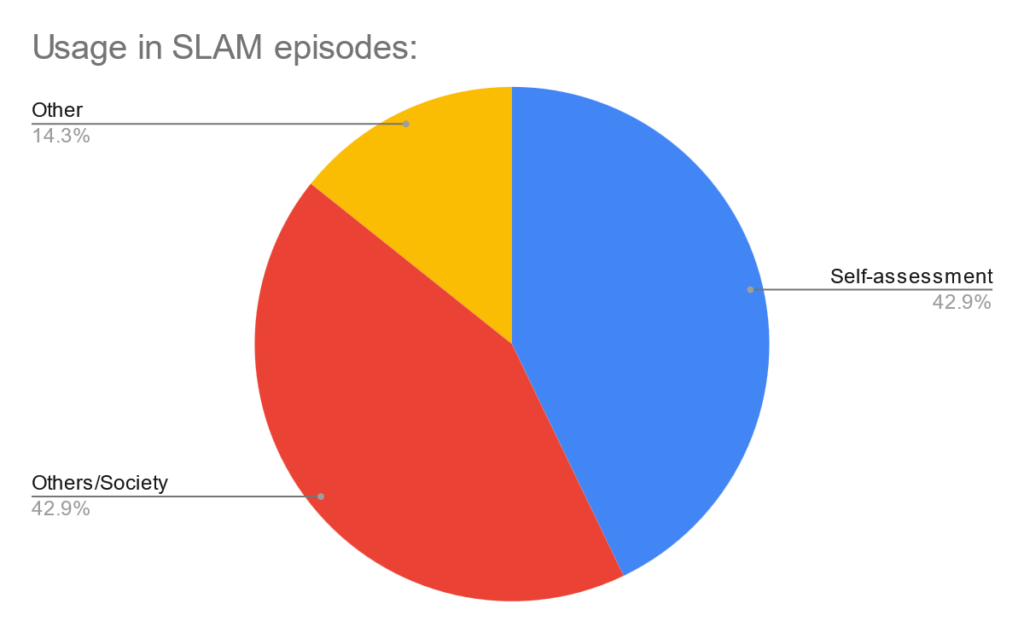
Full disclosure: Admitting to my own anticipations: I expected the majority of these comments to be about facing yourself in the mirror. Two surprises: (1) that these amounted to less than half of the total results, and (2) that “Relationships with Others/Society” would garner the same number of mentions.
This would seem to indicate a generalized awareness of artists’ perceived roles as social chroniclers/commentators.
As for the comments that do exhort the benefits of self-assessment; these are universally in favor, advising it as a positive exercise to bolster and build self-esteem and empowerment.
Remember to check out the continuation of this article here, with 25 more relevant musical references.
♫
References
-Queensrÿche. (1988). Operation: Mindcrime [Album]. EMI Manhattan.
-Michael Jackson (1987) Bad [Album]. Epic Records.
-Live (1991) Mental Jewelry [Album]. Radioactive.
-Jimi Hendrix (1971) Rainbow Bridge [Album]. Reprise.
-Metallica (1986). Master of Puppets [Album]. Elektra Records.
-Diana Ross (1981). Why Do Fools Fall in Love? [Album]. Capitol (Europe), RCA (North America)
-The Doors (1967). Strange Days [Album]. Elektra Records.
-Natalia Kills (2011). Perfectionist [Album]. Cherrytree Records.
-Def Leppard (1981). High n’ Dry [Album]. Vertigo.
-Def Leppard (1987). Hysteria [Album]. Mercury.
-Lil Wayne feat. Bruno Mars (2011). Tha Carter IV [Album]. Young Money, Cash Money, Universal Republic.
-Overkill (1992). I Hear Black [Album]. Atlantic.
-Arcade Fire (2007). Neon Bible [Album]. Merge.
-Justin Timberlake (2013). The 20/20 Experience [Album]. RCA.
-Imagine Dragons (2015). Smoke + Mirrors [Album]. Interscope, KidinaKorner
-Huntrix (2025). KPop Demon Hunters (Soundtrack From the Netflix Film) [Album]. Interscope, KidinaKorner
-Aerosmith (1973). Aerosmith [Album]. Columbia.
-Aerosmith (1985). Done With Mirrors [Album]. Geffen.
-B.B. King (1969). Live & Well [Album] BluesWay.
-Blind Guardian (1998). Nightfall in Middle-Earth [Album]. Virgin/Century Media.
-Kendrick Lamar (2022). Mr. Morale & the Big Steppers [Album]. PG Lang, TDE, Aftermath, Interscope
Articles used as resources:
- https://discover.hubpages.com/entertainment/songs-about-mirrors
- https://bob-dylan.org.uk/archives/12838
♫
Sources and methodology:
- (Section 1) Through research and expertise, Jack Mangan selected a sampling of twenty different song lyric uses of mirrors as metaphors or images, spanning many different musical genres.
- (Section 2) The S.L.A.M. internal Data Research Education Awareness Music Team (D.R.E.A.M. Team) analyzed the full spoken content of 35 different “SLAM Summit” panel discussion recordings, tagging meaningful statements across various categories. This report focuses on quotes associated with the concepts of mirrors and reflections used in music arts.
- We did not seek to confirm or debunk the truth or validity of any statements made. The purpose was to analyze, process, quantify, draw logical connections, find meaningful commonalities, themes, and/or contradictions between the statements, and ultimately share the recorded observations, feelings, concerns, beliefs, philosophies, etc., in the speakers’ own words and lyrics. No judgments of the speakers/songwriters are intended, nor should any be inferred.
- (Section 2) The speakers were invited to participate in “SLAM Summit: Music Survival Guide” panel discussions. All episodes are publicly available or are scheduled for release at http://www.supportlifeandmusic.org/voices. The quotes in this report will be kept anonymous, and are not intended to be taken out of context as any kind of reflection on any persons involved in the conversations.
- (Section 2) Some of the content presented has been edited to:
- Remove extraneous words and phrases, like “you know,” “um,” “like,” etc., as well as to remove repeated or stammered words/phrases.
- Correct obvious Zoom transcription errors in translation, dictation, or grammar. (crosschecked against the actual episode audio.)
- (Section 2) No statement was changed, no quote was edited to directly or indirectly change its original meaning in any way.
- The “Conclusions” sections of this report were written solely in-house at Support Life And Music, and its recommendations are drawn from S.L.A.M. backgrounds in the music industry and mental health, as well as from the designated data set. All facts, figures, opinions, conclusions, and suggestions in this article are presented solely for informational purposes. There are mental health improvement techniques that can be undertaken by anyone in any situation to benefit themselves and others, but consultation with a certified mental health professional is always recommended. See the Support Life And Music website for an expansive list of healthcare providers.
♫
The Support Life And Music D.R.E.A.M. Team who helped with this article:
Jack Mangan
Dr. Sheila Unwin
Sarah Hyde
♫
*The first two D.R.E.A.M. reports draw solely from SLAM: Music Survival Guide transcripts.
October 2025: Substance Misuse
September 2025: Unique Risk Factors for Musicians
Top image credit: Nikita Grishin.