Category: Uncategorized

  • SLAM: Music Survival Guide 36 – I Want to Have More Time to Live

    SLAM: Music Survival Guide 36 – I Want to Have More Time to Live

    This week’s summit: the immortal author, publicist, musician, music expert, activist, survivor, DJ, badass: Nathan Carson of Nanotear.

    Lyrics reference: Conan

    Topics and quotes:
    -Any art that I appreciate, I like knowing where it comes from and what those people’s influences are, and so I think it’s just a natural curiosity for me to trace all those roots
    -Hole in the Sky, to me, is very much a better Black Sabbath song.
    -You’ve got people saying, “Well, concerts should be free, or $5. I grew up going to $5 shows, why isn’t it $5?”
    -You can see I’ve got a pretty good, scar across my neck. It looks like I came out of a Highlander movie, successfully.
    -I didn’t want to have to wrap up my affairs and sell my records and finish my novel in 6 months.
    -Making a list, or making a call, or making a plan.

  • SLAM: Music Survival Guide 35: CK Smile – Somebody Will Hear You

    SLAM: Music Survival Guide 35: CK Smile – Somebody Will Hear You

    Powerhouse frontman for Swiss Metallers, Chaoseum: CK Smile

    Lyrics reference: Korn

    Topics and Quotes:
    -You have to speak a very, very great language, very intellectual, to sing in French.
    -I needed to tell many things that I kept very… for a long, very long time, inside my body, inside myself, my brain.
    -Try to understand that no one will come to knock to your door to save you.
    -Because many people can’t understand that, and they don’t want to understand, because maybe they’re afraid, we don’t know.

    http://chaoseum.com/

  • SLAM: Music Survival Guide 34 – Terra Incognita

    SLAM: Music Survival Guide 34 – Terra Incognita

    SLAM: Music Survival Guide 34 – Terra Incognita

    All-Star panel:
    Kevin J. Anderson (Bestselling novelist behind the Terra Incognita trilogy, plus the Clockwork Angels series with Neil Peart of RUSH, and numerous other titles in major franchises, including Dune and Star Wars).
    Michael Sadler – Founding member of iconic prog band: Saga.
    Bob Madsen – of The Highlander Company Records, also known for “flippity-flappity bass”

    Lyrics reference: Rush

    Quotes:
    -The record business is broken. We don’t know what we’re doing.
    -I really know how to write books, but I don’t play any instruments.
    -I’m quite willing to sing outside of my comfort zone, as it were, with Saga. In fact, I invite it, because I really enjoy doing that and expanding my range.

    https://wordfirepress.com/collections/terra-incognita
    https://sagagen.com/
    https://thehighlanderco.com/

    https://www.supportlifeandmusic.org/

  • Support Life And Music Receives Grant from the Arizona Eastern Star Foundation

    Support Life And Music Receives Grant from the Arizona Eastern Star Foundation

    FOR IMMEDIATE RELEASE
    11/25/2025
    Phoenix, AZ

    Incredible news from the S.L.A.M. Universe!
    Support Life And Music is honored to be a grant recipient of the illustrious Arizona Eastern Star Foundation!

    The Arizona Eastern Star Foundation, a recognized 501(c)(3) entity, provides grants to support charitable organizations throughout the state. Its mission is to relieve suffering caused by abuse, illness, neglect, or poverty by funding hospitals, medical research, and educational programs. AESF welcomes public donations to expand its reach and impact. Governed by a volunteer board, the foundation remains a vital resource for Arizona communities, channeling funds to qualified charities.

    For more information about the Arizona Eastern Star Foundation, please visit https://www.azoes.org/az-oes-foundation.html.

    AESF’s generous support will add power and strength to our existing programs, especially D.R.E.A.M. (Data, Research, Education, Awareness, and Music).

    All of us here at S.L.A.M. wish to extend our deepest gratitude to AESF. We are proud to be associated with them, and we look forward to tremendous accomplishments in 2026.

  • D.R.E.A.M. – Through the Mirror (cont’d)

    D.R.E.A.M. – Through the Mirror (cont’d)

    Support Life And Music

    D.R.E.A.M.

    Data Research Education Awareness and Music

    III.2.

    Bonus Content for Support Life and Music D.R,E,A,M, Report III. “Through the Mirror: Artist Commentary on Mirrors and the Need For Self-Reflection.”

    This is a list of 25 more mirror/reflection-related music references, as seen in the original November 2025 Support Life And Music D.R.E.A.M. article. You don’t necessarily need to read that one first, but you can find it here.

    1. Jonathan Davis sings of the mirror as a target of hostility, smashing his face into one in Korn’s “Here to Stay.” 
    2. Norwegian Pop star, Sigrid, topped the charts with her Disco hit, “Mirror,” an upbeat ode to self-appreciation and empowerment.  
    3. Country singer Megan Moroney’s “Girl in the Mirror” has lost her damn mind / She used to know who she was, but now wonders why she’s “not enough.”
    4. A mirror is an enabler of narcissism for the object of Carly Simon’s scorn when he enters the room in “You’re So Vain.” 
    5. Nine Inch Nails – “Shit Mirror” (2018). Trent Reznor sees something hard to recognize, something with power and strength and appetite in the mirror after something has gone too far. Ominously, he seems to like this new mutation. 
    6. As Queen’s “Somebody to Love” begins, Freddie Mercury looks in the mirror and cries from loneliness. The song is affectionately Gospel-tinged Rock n’ Roll, focused on a desperate prayer to God or anybody to find him somebody to love.  
    7. UK Pop duo Ider had a hit with the song, “Mirror.” It’s an ode to insecurity after the singer’s partner has left, repeating the phrase, “Heal me.” 
    8. Uriah Heep – Look At Yourself. This 1971 song implores the listener to stop running, to stop being afraid and look at themselves. While no mirror is specifically mentioned, the “Look at Yourself” vinyl album cover featured a reflective foil square with two eyes above it. 
    9. Joe Henderson. “Mirror, Mirror.” (1980). Jazz instrumental with Chick Corea, Ron Carter, Billy Higgins. Another nod to the ubiquitous line from Disney’s “Snow White and the Seven Dwarfs.” 
    10. K-Pop giants BTS have a 2016 song called, “Reflection,” which is about struggling with self-loathing and self-love, happiness and despair.  
    11. In “Mirror” (2025) from the “Twilight Override” album, Jeff Tweedy (famously of Wilco) sings of introspection and reinvention. In this case, the mirror may be metaphorically describing the object of the song, rather than a literal reflection. “You are the mirror and the face.” 
    12. Two versions of “Reflection” appear in the 1997 animated Disney film, “Mulan,” itself a movie about a young woman of ancient China pretending to be a man in order to be a soldier in the army against the Huns. The song is written by Matthew “Break My Stride” Wilder and David Zippel; the version in the film is sung by actress Lea Salonga (1997). The Poppier end credits version is the debut single from Christina Aguilera (1997). The song is about hiding her true identity, and wanting her reflection to show who she “really is inside.” Christina Aguilera would later sing about keeping a positive self-image “no matter what they say” in possibly her signature song: “Beautiful” (2002). 
    13. “House of Mirrors” by Hollywood Undead (feat, Jelly Roll) leans into a few mirror symbolisms. The lyrics find him running from his father’s tragic history and his own, running from himself, wanting to see a hero, but only seeing a terrified child. “Broken mirrors, broken glass / I’m picking up pieces of my broken past.”
    14. In Arch Enemy’s “House of Mirrors,” you’re never alone, locked into a place, choosing between future and past. Honestly, I’m not fully sure what this line means: “Renegade are reflections made across a sharpened blade,” but it sounds cool.  
    15. In Taylor Swift’s “Mirrorball,” she’s aware that she looks impressive, but that she’s really just a number of tiny fragments, trying hard to please others, denying herself to appear as others want her to be. 
    16. In Meat Loaf’s “Objects in the Rear View Mirror May Appear Closer Than They Are,” from 1994’s “Bat Out of Hell II: Back Into Hell,” songwriter Jim Steinman writes of being haunted by past tragedies, echoing Meat Loaf’s 1970s smash “Paradise By the Dashboard Light” with the repeated line, “It was long ago, and it was far away.” 
    17. Bob Dylan has returned often to the mirror over his vast catalogue. In “Mama, You’ve Been on My Mind” from 1964, he sings to a past lover: “When you wake up in the morning, baby, look inside your mirror / You know I won’t be next to you, you know I won’t be near / I’d just be curious to know if you can see yourself as clear / As someone who has had you on his mind,” suggesting that she may not understand herself as well as he does. 
    18. In Heathen’s cutting 1987 political critique, “Pray For Death,” they implore the listener to own their own responsibility, to look in the mirror and see the lies. “For it’s just a picture seen through their eyes.”   
    19. In Doug E. Fresh and the Get Fresh Crew’s “La Di Da Di,” Slick Rick uses the Snow White “Mirror, Mirror” reference to comedically showcase his own vanity, asking it “Who’s the top choice of them all?” To which it replies, “You are, you conceited bastard!” The song was covered by Snoop Dogg in the 1990s. 
    20. In “My Mirror Speaks” from Death Cab For Cutie, the mirror minces no words. In it, he helplessly sees the signs of his body growing older.  
    21. In “Go to the Mirror!” from The Who’s Rock Opera, “Tommy” (1969), about a deaf, dumb, and blind pinball wizard, the mirror is a place of healing, solitary self-growth, and isolation. A doctor orders Tommy to “Go to the mirror, boy!” but remains perplexed by his unresponsiveness. “Look at him in the mirror dreaming / What is happening in his head?” 
    22. Paramore – Playing God (2010). Alt Pop Rock. Mirror as defiant empowerment; standing up to a judgmental person, saying “Next time you point your finger, I’ll point you to the mirror;” I.e., “Instead of looking critically at me, look at yourself.” 
    23. Clap Your Hands Say Yeah – Mirror Song (2022). The song seems to be about two self-destructive alcoholics in an unhealthy relationship. The symbolism is a bit unclear for this one; there’s no mention of a mirror, introspection, or reflection – – only  a “dressing bathroom stall with alcohol,” presumably with a physical mirror nearby. Perhaps because both participants are collapsing separately but together, mirroring each others’ downfall? 
    24. Black Sabbath – Sabotage (1975). No song or lyric, but the striking, oft-derided album cover shows the impossible scene of the band facing away from a mirror, with duplicate images – – not reflections – – of themselves staring out. A generous read could find them in denial, struggling to face themselves. 
    25. Descendants – Rotten to the Core (2015); credited artists: Sofia Carson, Dove Cameron, Cameron Boyce, Booboo Stewart. More Snow White stuff. This Kidz Bop-adjacent song from Disney’s teen musical may be a direct reference to the original Snow White and the Seven Dwarfs. “Mirror, mirror on the wall / Who’s the baddest of them all?” The movie centers on the ill-behaved children of classic Disney villains reinventing themselves, so maybe there is some subtext here. . . 

    One final reference: Not a lyric, but who can forget Jerome Benton bringing a mirror onstage so Morris of Morris Day and The Time could check his hair?

    Conclusions:

    The examples and usages listed here continue many of the themes and trends identified in the original D.R.E.A.M. “Mirror” article. A few new observations are listed below. The analysis provided here is based on this selection of 25 songs, as well as my personal professional music background. My own knowledge gaps and fallibilities must be acknowledged as factors. This is not an attempt to encompass all musics and all of the myriad uses of mirrors as metaphor and literal objects in songs. 

    The following common themes can be found in the song lyrics referenced above: 

    • Awareness of aging and mortality.
    • Self-confrontation.
    • Insecurity.
    • Vanity. 
    • Discomfort/dissatisfaction with the reflection. 
    • Drug use. Specifically cocaine. 
    • Mirror as symbolism. 
    • Reflections of others/society, often with defiance.
    • Distorted views and/or presentations of self and others.

    While mirror lyrics often refer to literal looking glass views, they are commonly used as metaphors for introspection, self-reflection, or reflection of others. The more you dig, the more callbacks you find to the Evil Queen’s “Mirror, mirror on the wall” dialogue from the 1937 “Snow White and the Seven Dwarfs” film. This apparently struck a cultural chord. 

    Articles used as resources:

    Sources and methodology:

    • (Section 1) Through research and expertise, Jack Mangan selected a sampling of twenty different song lyric uses of mirrors as metaphors or images, spanning many different musical genres. 

    Korn (2002). Untouchables [Album]. Epic Records 

    Sigrid (2022). How to Let Go [Album]. Universal Island Records Ltd. 

    Megan Moroney (2023). Lucky [Album]. Columbia Nashville  

    Carly Simon (1972). No Secrets [Album]. Elektra

    Nine Inch Nails (2018). Bad Witch [Album]. The Null Corporation, Capitol

    Queen (1976). A Day at the Races [Album]. EMI – Elektra

    Ider (2019). Emotional Education [Album]. Glassnote Records

    Uriah Heep (1971). Look at Yourself [Album]. Mercury Records

    Joe Henderson (1981). Mirror Mirror [Album]. MPS – Pausa

    BTS (2016). Wings [Album]. Big Hit – Loen – Pony Canyon

    Jeff Tweedy (2025). Twilight Override [Album]. Legacy Recordings

    Lea Salonga (1997). Mulan: An Original Walt Disney Records Soundtrack [Album]. Walt Disney Records

    Christina Aguilera (1997). Mulan: An Original Walt Disney Records Soundtrack [Album]. Walt Disney Records

    Hollywood Undead (feat. Jelly Roll) (2022). Hotel Kalifornia [Album]. Dove & Grenade Media – BMG

    Arch Enemy (2022). Deceivers [Album]. Century Media

    Taylor Swift (2020). Folklore [Album]. Republic

    Meat Loaf (1994). Bat out of Hell II: Back Into Hell [Album]. MCA Records

    Bob Dylan (record: 196, released 1991). The Bootleg Series Volumes 1–3 (Rare & Unreleased) 1961–1991. Columbia

    Heathen (1987). Breaking the Silence [Album]. Combat Records

    Doug E. Fresh and the Get Fresh Crew (1985). The Show [Single]. Reality – Fantasy 

    Death Cab For Cutie (2009). The Open Door EP [EP]. Atlantic – Barsuk 

    The Who (1969). Tommy [Album]. Track – Decca 

    Paramore (2010). Brand New Eyes [Album]. Fueled By Ramen

    Clap Your Hands Say Yeah (2021). New Fragility [Album]. Self-released – Secretly Canadian

    Black Sabbath (1975). Sabotage [Album]. Warner Bros. 

    Descendants Cast (2015). Descendants [Album]. Walt Disney Records

    The Support Life And Music D.R.E.A.M. Team who helped with this article:

    Jack Mangan
    Dr. Sheila Unwin
    Sarah Hyde

  • Brian Baker – The Road

    Brian Baker – The Road

    The Road – Brian Baker

    2025 Akashic Books
    Art Direction and Curation: Jennifer Sakai

    Brian Baker is one of the greatest guitarists of Punk Rock history, with a resume as long as his Gibson’s fretboard, including historic stints with Bad Religion, Minor Threat, Samhain, Dag Nasty, and many others. He’s lived, seen, felt, breathed, and tasted the professional musician lifestyle. 

    He collaborated recently with award-winning photographer, Jennifer Sakai, on a 2025 book simply entitled, “The Road,” featuring photos and images of interesting things in his life “over a period dating precisely from the debut of the first iPhone to the present day.”  

    Many fans and general public associate glamour, sleaze, or some combination of the two with the touring musician, but Brian’s photos touch on the wondrously mundane and gritty day-to-day stuff along the road. It sounds like the kind of project anyone could do, but Brian Baker has shown a canny eye for evoking fascination and relevance from the barely-visible, disregarded objects of the world.

    Every picture in this book is a story unto itself, begging further questions. Brian’s lens captures on-the-job curios, artifacts, and sometimes people and places, stolen from fleeting moments. There are no post-effects or touch-ups, no trained poses, no set pieces, no sweeping vistas or landscapes, just snaps of the world around him. He eschews gloss and glitz. Likewise, Baker is not drawn to junk, but rather to functional items and signs in disrepair. His photographic trade is in the weathered, timeworn, careworn, replete with dirt, flaking paint, and missing letters. My favorites are the various pictures of instruments, the statues, and the hand-drawn “A-Team” poster. 

    The book itself is not ratty in your hands; Akashic Books have produced a gorgeous, sturdy tome, sure to draw attention on your coffee table or bookshelf. 

    Musicians and industry figures will find value in this collection because its pictures speak truth. Nothing burned-out or apocalyptic, nothing horrific, but also nothing shining, grandiose, or pristine. It tells the real story of the boredom, the wonder, the simple beauty in the minutiae of the road life. 

  • D.R.E.A.M. – Through the Mirror: Artist Commentary on Mirrors and the Need For Self-Reflection

    D.R.E.A.M. – Through the Mirror: Artist Commentary on Mirrors and the Need For Self-Reflection

    Support Life And Music
    D.R.E.A.M.

    Data, Research, Education, Awareness, and Music

    III.

    Through the Mirror: Artist Commentary on Mirrors and the Need For Self-Reflection. 

    The following report has two sections: the first is a sampling of pop culture lyrics references, and the second draws from SLAM: Music Survival Guide transcripts.* Both are focused on artists’ commentary around the significance of self-reflection. In the latter section, no interpretations or usages of the terms have been excluded, whether the use was literal, metaphorical, or ambiguous. 

    Mirrors are a common recurring theme in religious texts and classic literature, including:

    • Shakespeare’s “mirror crack’d” framing of the struggles of Hamlet and those around him. 
    • “Mirror, mirror on the wall,” from the seminal 1937 Disney film, “Snow White and the Seven Dwarfs,” became one of the most recognizable phrases of the 20th Century, and is often repurposed elsewhere in pop culture, especially in song lyrics. 
    • J.R.R. Tolkien and later J.K. Rowling – – along with numerous other creators – – have used magic mirrors to reflect other possible realities and futures. 
    • Lewis Carroll, Susannah Clarke, John Carpenter, and countless others have used mirrors as portals to other dimensions and places in their storytelling. 
    • Back in the real world, a mirror is a common platform for cutting and snorting lines of cocaine, one of the most well-known and destructive addictive drugs. This imagery is often found in stories and songs. 
    • The idiom, “smoke and mirrors” has gained traction since the 1970s, widely-credited to Jimmy Breslin’s use of it in describing the trickery around US President Richard Nixon’s Watergate scandal and impeachment proceedings. The phrase itself is a reference to the old-time magician’s method of using “smoke and mirrors” to fool their audiences. 
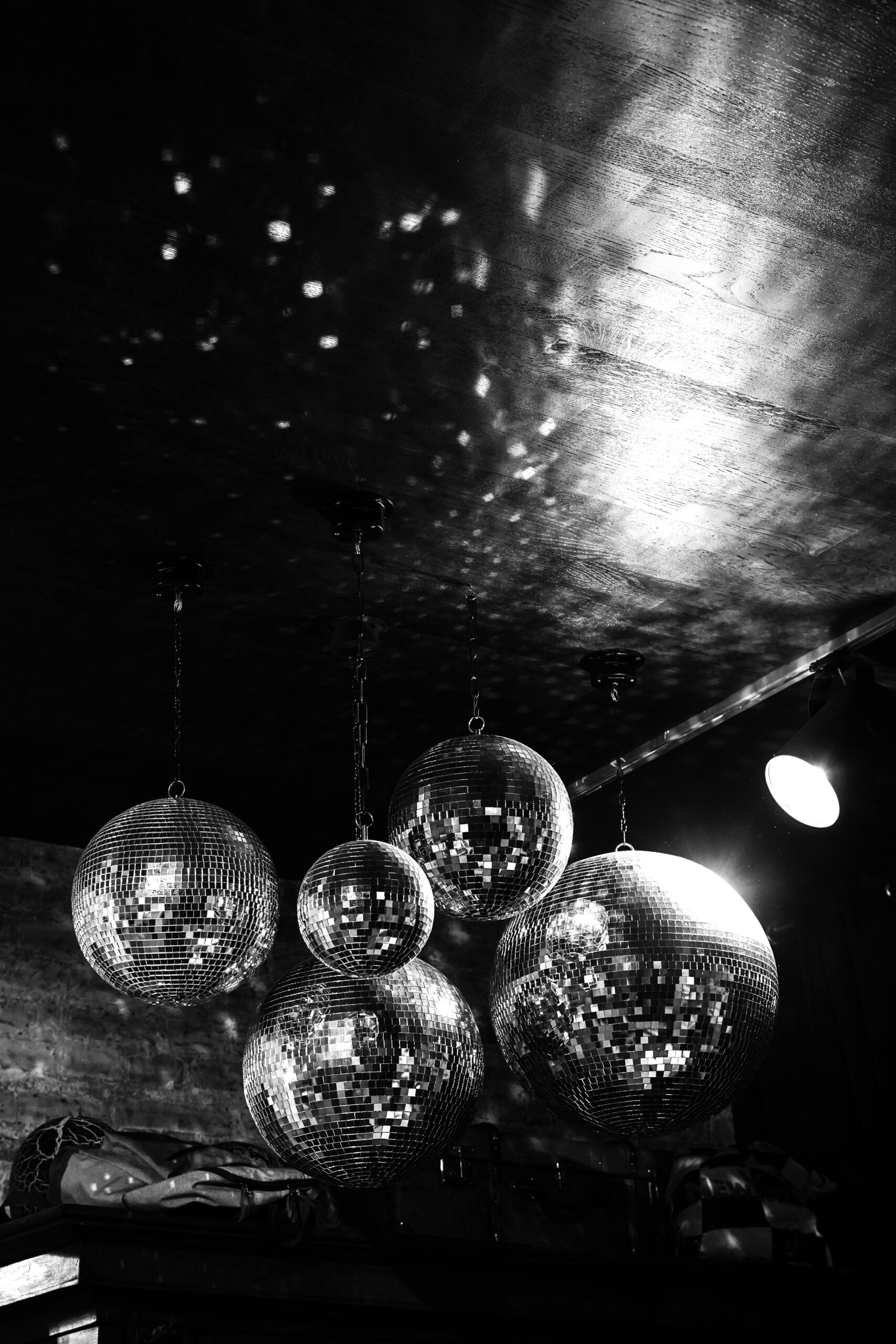
    • A mirrorball has become emblematic of dance clubs and music halls, hanging from the ceiling and scattering light reflections in numerous directions (Sarah McLachlan released a 1999 live album entitled “Mirrorball;” Neil Young collaborated with Pearl Jam on the 1995 record “Mirror Ball.” Pearl Jam then released a companion EP called “Merkin Ball.” Taylor Swift has a 2020 song titled “Mirrorball.”) 
    • Carnivals of the 19th, 20th, and 21st century often feature a “House of Mirrors” attraction, which are usually mazes of mirrored walls, intended to be disorienting. These are closely related to funhouse mirrors, which distort the reflection.

    There is no way of tracking prehistoric use of water and ice as a reflective surface; the first human-created mirrors were made of obsidian in 6000 B.C. The ability to view one’s own reflection has been with us for millennia; it’s part of the human experience. Pop culture mirror references abound into infinity (unintended pun acknowledged).  

    Section 1. 20 Lyrical Mirror References. 

    Pop culture and musical references to mirrors are myriad and endless. We’ll present 20 here in the first section from diverse musical genres to show some of the far-reaching and arrayed uses* (25 more appear in a separate, bonus D.R.E.A.M. report):

    1. Queensryche’s (1988) concept album, “Operation: Mindcrime,” closes with the lead character staring into the “Eyes of a Stranger,” after his addiction has led him past redemption, acknowledging that “the mirror never lies.” 
    2. Michael Jackson (1987) confronts the “Man in the Mirror,” not for his own sake, but to ask him to change his ways in order to make the world a better place. 
    3. Like Michael Jackson, Live’s Ed Kowalcyk (1991) wants to do more good in the world in “The Mirror Song,” but he can’t seem to help himself, looking to “flags and mental jewelry” for definition.   
    4. Jimi Hendrix (1971) could only see himself when he lived in a “Room Full of Mirrors,” but once he smashed them, the whole world was there for him to see. The mirror in this case enables selfishness and obstructs connection with others. 
    5. With “Chop your breakfast on a mirror,” Metallica (1986) identify the mirror as a conveyance of self-destruction and the corruption of life norms. This lyric can be found in their anti-cocaine/addiction opus, “Master of Puppets.” 
    6. Diana Ross invokes the Snow White reference in her (1981) hit, “Mirror, Mirror,” but not as an evil queen. In this song, she blames the mirror itself for misleading her and giving her false hope. The mirror also reflects aging. It “nails her heart to the wall” for its pleasure, while she remains trapped in it forever, watching herself get older.  
    7. The face in the mirror “won’t stop” in one of Jim Morrison’s meditations on death for The Doors’ “When the Music’s Over” (1967). 
    8. The mirror’s “gonna fog tonight” in Natalia Kills’ sexually-charged Pop smash, “Mirrors” (2011).
    9. In Def Leppard’s “Mirror, Mirror (Look Into My Eyes),” (1981) singer Joe Elliott struggles to believe it’s really him in the cracked mirror. Def Leppard are notorious for their Rock n’ Roll excesses. This song was co-written by guitarist Steve “Steamin’” Clark, whose life would end at 30, due to a lethal mixture of alcohol and prescription drugs.  
    10. Def Leppard would return to the mirror imagery in their Billboard #1 heartbreak ballad, “Love Bites” (1987), in which the singer asks his ex-lover if she looks in the mirror when she makes love, and if her new lover looks like him. Again using the mirror as a vessel for insecurity and self-doubt. 
    11. Lil Wayne’s song, “Mirrors (feat. Bruno Mars)” 2011 powerfully sets the scene of looking to the mirror for self-assurance, self-assessment, introspection, and self-reflection (literal and figurative).
    12. Bobby “Blitz” Ellsworth’s mirror “spits reflections of a lie” in Overkill’s take on self-deception in “Feed My Head.” (1993)
    13. Arcade Fire’s “Black Mirror” (2007) presents a cold, uncaring, apocalyptic image. 
    14. Justin Timberlake uses mirror imagery seductively in his “Mirrors” song. (2013)
    15. The title track from Imagine Dragons’ “Smoke + Mirrors” (2015) references the singers’ disillusionment with organized religion. 
    16. Huntrix, the fictional K-Pop girl-group of the animated KPop Demon Hunters movie, put a modern twist on the Snow White mirror with their swaggering bravado anthem, “How It’s Done” (2025). “Need to beat my face, make it cute and savage / Mirror, mirror on my phone, who’s the baddest? (Us, hello?)” Not an ounce of self-doubt here; this is full empowerment. They sing/rap this song while effortlessly dispatching demons.
    17. Steven Tyler of Aerosmith sings of seeing signs of getting older in his mirror in “Dream On” (1973). Aerosmith would later release an album entitled “Done With Mirrors” (1985), an intentional reference both to magician’s trickery and to cocaine use. This album was made and released while the band attempted a new beginning after years of heavy drug use, which had garnered Tyler and guitarist Joe Perry the nickname, “The Toxic Twins.” 
    18. Like Aerosmith and Diana Ross, B.B. King also sees Father Time catching up with him in the song, “Why I Sing the Blues” (1969). “I look in the mirror everyday / And let it tell me the truth.” 
    19. Blind Guardian’s fan-favorite, “Mirror, Mirror,” from their album, “Nightfall in Middle-Earth” (1998) uses Tolkien’s magic High Fantasy world as a setting for this scene of a leader’s struggle with the best decisions for the fate of themself, their friends, and the entire world.
    20. Rapper Kendrick Lamar uses a mirror to liberate himself from the pressures of others, suggesting that they view themselves in it, then turn it on him to reflect his freedom. “I choose me, I’m sorry.” This is for his fifth album’s outro track: “Mirror.” (2022)

    Conclusions for Section 1:

    The examples and usages go on forever in popular music. The analysis provided here is based on this sampling of 20 songs,* as well as my personal professional music background. My own knowledge gaps and fallibilities must be acknowledged as factors. This is not an attempt to encompass all musics and all of the myriad uses of mirrors as metaphor and literal objects in songs. 

    The following common themes can be found in the song lyrics referenced above: 

    • Awareness of aging and mortality.
    • Self-confrontation.
    • Insecurity.
    • Discomfort/dissatisfaction with the reflection. 
    • Drug use. Specifically cocaine. 
    • Mirror as symbolism. 
    • Reflections of others/society, often with defiance.

    While mirror lyrics often refer to literal looking glass views, they are commonly used as metaphors for introspection, self-reflection, or reflection of others.
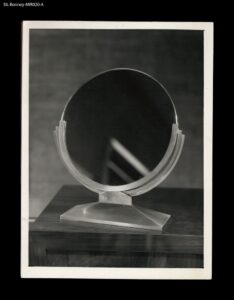
    France, ca. 1926. Table-top dressing mirror in polished metal. Compagnie des Arts Francais, designer.

    Section 2. SLAM: Music Survival Guide transcripts

    Of the references listed in section 1, The Lil Wayne, Def Leppard, Diana Ross, Sigrid, Michael Jackson, and Live quotes hew closest to the relevant mirror-related messages and themes uncovered in the SLAM: Music Survival Guide episode transcripts. What follows is a list of organized quotes from these episodes. The nonattributed quotes are taken from pro musicians, music industry workers, and mental health professionals. 

    Keywords and phrases used:
    “mirror”
    “look at yourself”
    “reflect”
    “reflection”
    “see yourself” 

    “Introspection” (zero results)

    • I started to learn more about self and self responsibilities, taking accountability for your own actions within yourself. . . If you can sit in a room and look in a mirror, and you are. . . okay with what you see. . . sounds a little cliche, but it’s true.
    • You have to meet you, and the best way to meet you is, go front of the mirror and speak to you. How can you say, “I love you?” And if you can’t say, “I love you,” but now you have to work on you. That’s the solution on my side.
    • A lot of it comes down to the voices in your head, and so it comes down to you, developing these techniques of kinda not listening to those voices, or telling… turning the story around and telling a different story than maybe what those voices are telling you. And I don’t mean voices like you’re crazy, but you know what I’m saying. The things you think in your head, like, when you look in the mirror and you say, “Oh man, I look fat today,” or whatever. You know, maybe you look in the mirror and say, “You know, I don’t look so bad today.” It’s just a matter of changing that. And so there are little tools and things like that that you can do.
    • We were looking at the extent to which the level of success you thought that you had impacted your level of well-being. Seeing that those who don’t view themselves as successful struggle with their mental health and well-being, like obviously so, and that forces you to then to have a conversation of, like, “What is success for you?” And I think, particularly as you get older, by which I mean you sort of care less about the opinions of others like, I’m 38 now, like I care much less about the opinions of others than I did when I was 21, or whatever. And what that means is you can then have a look at yourself, without judging yourself, like; what other things make you happy?
    • Do you see yourself as successful? Yes, no, or don’t know. People that say “No” have worse mental health and well-being outcomes. So the question is: what does success mean to you? How do you define it?
    • Personally for me, stepping away from a situation and being able to just reflect on trying, trying to reflect and. . . realize who I was, or who I’ve been my entire life, and just trying to embrace this person. But to step away and just really take a breather, and just to see everything, the big picture. . . It could take weeks. It could take months, but some it’s necessary, you know. . . As you said, it comes from within. You have to love yourself first, and if you can’t love yourself, you’re not going to love anything else. So you’re just going to be cynical and just a complete a-hole to most people. You just have to really come to terms with who you are. And if you’re comfortable with that, then you can be comfortable with moving on with your life.
    •  No matter where you are in the world. You’re feeling these things of sadness and loss and love and all that kind of stuff. And that’s generally the human condition, right? We want to exercise that kind of stuff and relate to other people. And that’s kind of what we do, you know, through the dawn of time. That’s art, right? People see it, hear it, and reflect, and you know, just kind of resonate with it.
    • I use the comic book as a tangible thing for the kids and talk to them about tapping into your inner mega powers. And I talked to them about some of my experiences, but reflected more onto them. And so then they can be like, wow, you know, with music or with anything in art, we have that point to where we think it’s gonna be IT. And then, years later, being able to spin it out into so many other things that still reflect my love for music, but has been able to evolve without me, holding on to that thing that happened to me, and continuing to be like something that hold me down and spin out. Hope!
    • Musicians are part of a society, and to an extent, their behaviors are reflections of that society. So, having a richer understanding, a richer kind of anthropological, sociocultural understanding of the relationships between a musician’s psychology and the society they live in is something that I’ve always been very interested in.
    • What takes place in music, and in particular, in certain kind of genres and subcultures, and the extent to which they might be a mirror or a reflection of the society.  
    • (Defining) objective determinants of “professional:” So this was like: being played on the radio, having a manager, having a tour manager, having the apparatus of the music industry around you. . . The first thing you see is: they don’t correlate at all. So lots of people say “Yes (I’m a professional musician),” and they have none of those things. Lots of people have all of those things and say, “No.” They don’t mirror at all.
    • Even on stage, you’re exposing yourself. Don’t listen to anybody who has a negative comment, because there’s a lot of people, people who have negative comments, they’re just mirroring themselves.
    • When I was coming up, music represented the conditions that we lived in. People sang about, free love and they sang about oppression, and the war, and all of those things. Music is always reflective of our condition. And so, I say that simply: Keep your message in touch for our higher self, so that we can be better as a. . . not just a community, but as a country. We should have music that talks about our love, our support, and all of the good things we do. Not all of the negative things that we have to deal with.
    • Context: The following quote is in response to the comment: “There’s a graph that shows up, and CEO pay looks like a hockey stick. And worker pay is a dead flat line.” I think that hockey stick you’re talking about, I think that if you look at a timeline, that mirrors artists’ relationships to getting paid. Because. . . in the 80s, you had a marginally successful song, you got a lot of money coming in from sales and play and all that, and then it got to the point in the early 2000s where the biggest new bands were just getting paid nothing. 

    Conclusion for Section 2:

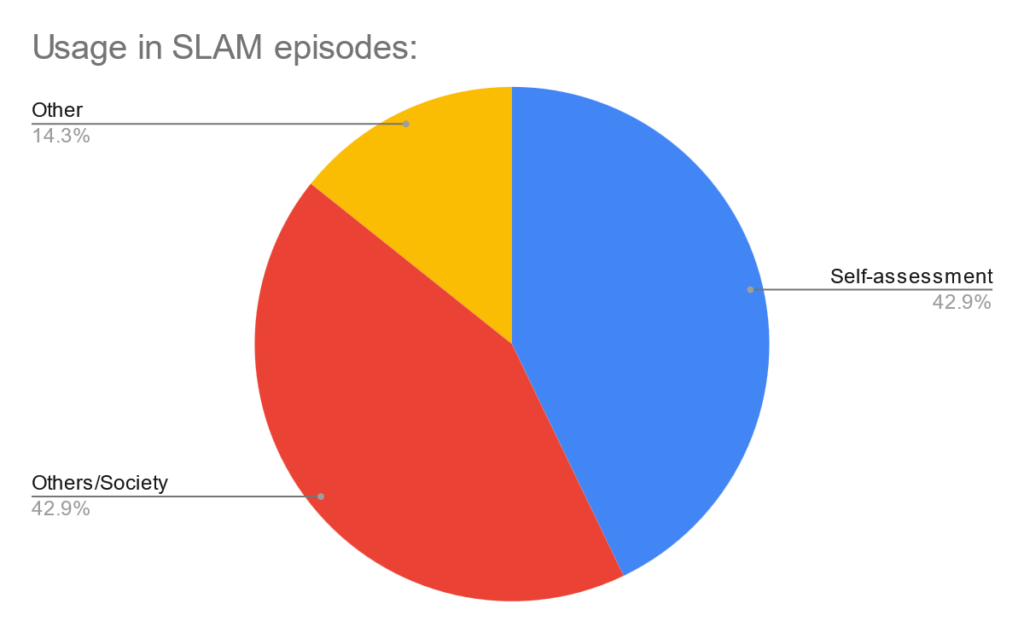
    Full disclosure: Admitting to my own anticipations: I expected the majority of these comments to be about facing yourself in the mirror. Two surprises: (1) that these amounted to less than half of the total results, and (2) that “Relationships with Others/Society” would garner the same number of mentions. 

    This would seem to indicate a generalized awareness of artists’ perceived roles as social chroniclers/commentators. 

    As for the comments that do exhort the benefits of self-assessment; these are universally in favor, advising it as a positive exercise to bolster and build self-esteem and empowerment. 

    Remember to check out the continuation of this article here, with 25 more relevant musical references.

    References

    -Queensrÿche. (1988). Operation: Mindcrime [Album]. EMI Manhattan.
    -Michael Jackson (1987) Bad [Album]. Epic Records. 
    -Live (1991) Mental Jewelry [Album]. Radioactive. 
    -Jimi Hendrix (1971) Rainbow Bridge [Album]. Reprise. 
    -Metallica (1986). Master of Puppets [Album]. Elektra Records. 
    -Diana Ross (1981). Why Do Fools Fall in Love? [Album]. Capitol (Europe), RCA (North America)
    -The Doors (1967). Strange Days [Album]. Elektra Records. 
    -Natalia Kills (2011). Perfectionist [Album]. Cherrytree Records. 
    -Def Leppard (1981). High n’ Dry [Album]. Vertigo. 
    -Def Leppard (1987). Hysteria [Album]. Mercury. 
    -Lil Wayne feat. Bruno Mars (2011). Tha Carter IV [Album]. Young Money, Cash Money, Universal Republic. 
    -Overkill (1992). I Hear Black [Album]. Atlantic. 
    -Arcade Fire (2007). Neon Bible [Album]. Merge. 
    -Justin Timberlake (2013). The 20/20 Experience [Album]. RCA.
    -Imagine Dragons (2015). Smoke + Mirrors [Album]. Interscope, KidinaKorner
    -Huntrix (2025). KPop Demon Hunters (Soundtrack From the Netflix Film) [Album]. Interscope, KidinaKorner
    -Aerosmith (1973). Aerosmith [Album]. Columbia. 
    -Aerosmith (1985). Done With Mirrors [Album]. Geffen. 
    -B.B. King (1969). Live & Well [Album] BluesWay. 
    -Blind Guardian (1998). Nightfall in Middle-Earth [Album]. Virgin/Century Media. 
    -Kendrick Lamar (2022). Mr. Morale & the Big Steppers [Album]. PG Lang, TDE, Aftermath, Interscope 

    Articles used as resources:

    Sources and methodology:

    • (Section 1) Through research and expertise, Jack Mangan selected a sampling of twenty different song lyric uses of mirrors as metaphors or images, spanning many different musical genres. 
    • (Section 2) The S.L.A.M. internal Data Research Education Awareness Music Team (D.R.E.A.M. Team) analyzed the full spoken content of 35 different “SLAM Summit” panel discussion recordings, tagging meaningful statements across various categories. This report focuses on quotes associated with the concepts of mirrors and reflections used in music arts. 
    • We did not seek to confirm or debunk the truth or validity of any statements made. The purpose was to analyze, process, quantify, draw logical connections, find meaningful commonalities, themes, and/or contradictions between the statements, and ultimately share the recorded observations, feelings, concerns, beliefs, philosophies, etc., in the speakers’ own words and lyrics. No judgments of the speakers/songwriters are intended, nor should any be inferred. 
    • (Section 2) The speakers were invited to participate in “SLAM Summit: Music Survival Guide” panel discussions. All episodes are publicly available or are scheduled for release at http://www.supportlifeandmusic.org/voices. The quotes in this report will be kept anonymous, and are not intended to be taken out of context as any kind of reflection on any persons involved in the conversations. 
    • (Section 2) Some of the content presented has been edited to:
      • Remove extraneous words and phrases, like “you know,” “um,” “like,” etc., as well as to remove repeated or stammered words/phrases. 
      • Correct obvious Zoom transcription errors in translation, dictation, or grammar. (crosschecked against the actual episode audio.)
    • (Section 2) No statement was changed, no quote was edited to directly or indirectly change its original meaning in any way. 
    • The “Conclusions” sections of this report were written solely in-house at Support Life And Music, and its recommendations are drawn from S.L.A.M. backgrounds in the music industry and mental health, as well as from the designated data set. All facts, figures, opinions, conclusions, and suggestions in this article are presented solely for informational purposes. There are mental health improvement techniques that can be undertaken by anyone in any situation to benefit themselves and others, but consultation with a certified mental health professional is always recommended. See the Support Life And Music website for an expansive list of healthcare providers. 

    The Support Life And Music D.R.E.A.M. Team who helped with this article:

    Jack Mangan
    Dr. Sheila Unwin
    Sarah Hyde


    *The first two D.R.E.A.M. reports draw solely from SLAM: Music Survival Guide transcripts. 

    October 2025: Substance Misuse 

    September 2025: Unique Risk Factors for Musicians

    Top image credit: Nikita Grishin.
  • From Buzz to Bond

    From Buzz to Bond

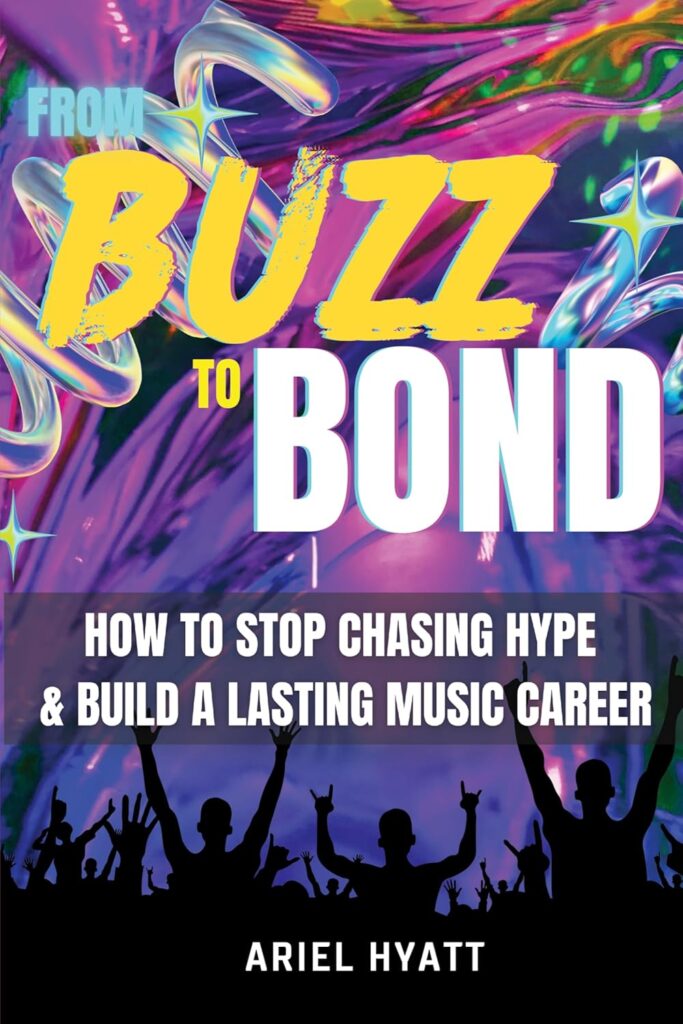
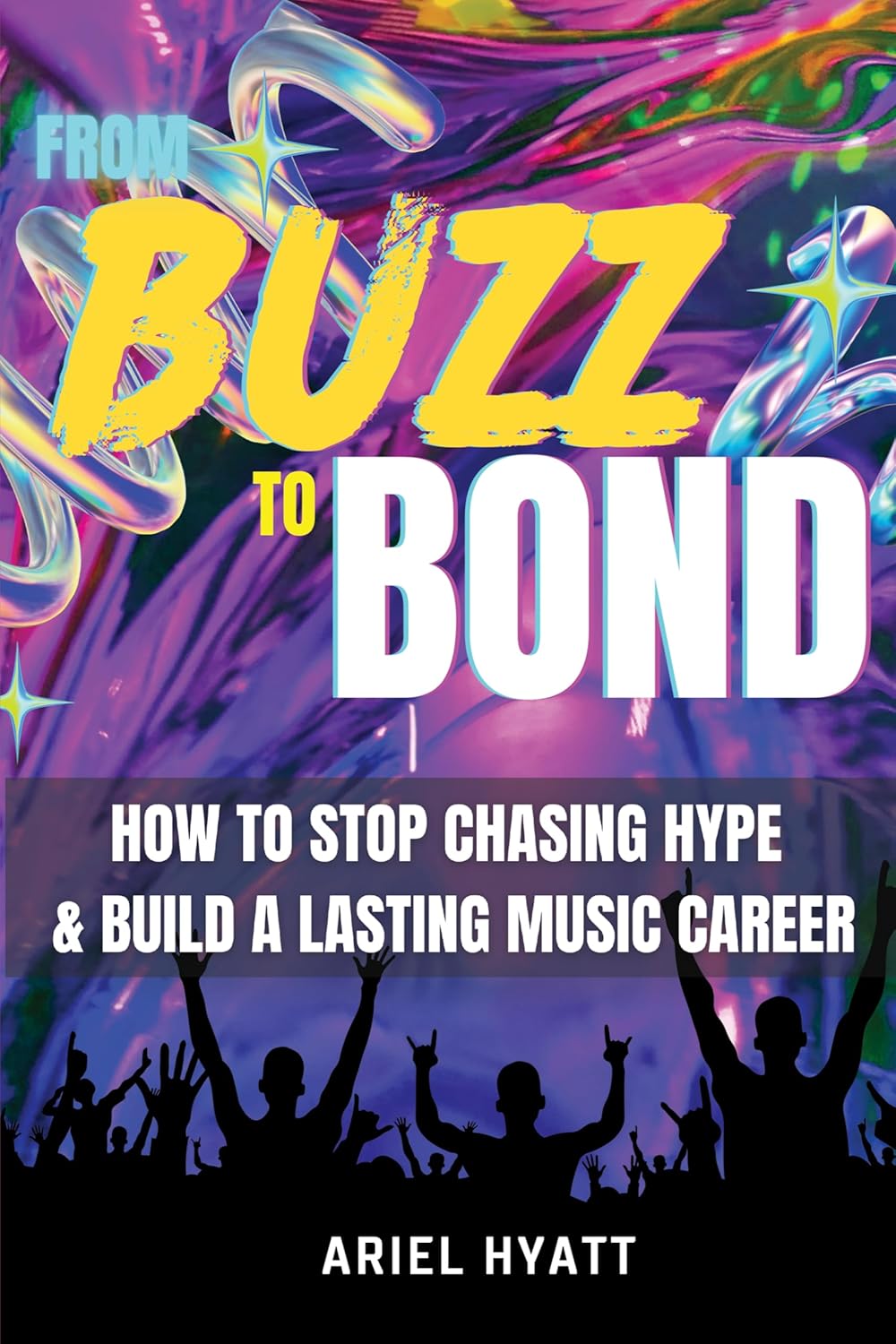
    Ariel Hyatt is years ahead of the curve.
    As the founder of CyberPR, she’s one of the leading Subject Matter Experts (SMEs, for you business folks) in the music world. From her bio: “She is known throughout the industry for her books, and dedication to education and she loves teaching artists which she has done in 12 countries for over 100,000 creatives helping them take control of their marketing.” Her latest book demonstrates her deep understanding of the trends and needs and best practices required to make it in this industry.

    “From Buzz to Bond” is an essential guide for the 21st-century music career, whether you’re a musician, publicist, agent, manager, or superfan. This book expertly dispels common misconceptions about viral wins and social media dopamine hits, while presenting a powerful, effective, fully-realized strategy for deeper connections and long-lasting musical success. Every up-and-coming musician – – and every scene veteran – – needs to read and implement the steps outlined in these pages. Ms. Hyatt employs real anecdotes, clear languages, and diagrams to convey her messsages. She first debunks the commonly-held notion that fleeting, viral online attention is the path to meaningful success, but then offers a precisely-detailed methodology to earn sustainable, consistent wins through an engaged fanbase.


    It’s a short book with a punch, so I won’t give away too much of the content. Most of the concepts in “From Buzz to Bond” could easily apply to professionals in other creative fields as well.
    Stop chasing trends. Cultivate the right kinds of attention.

    Highly recommended.

    https://cyberprmusic.com

  • D.R.E.A.M. – Substance Misuse

    D.R.E.A.M. – Substance Misuse

    Support Life And Music

    D.R.E.A.M.

    Data Research Education Awareness Music

    Substance Misuse Concerns for Musicians

    v. 1.0 

           October 12, 2025

    Purpose: 
    To identify and analyze SLAM Summit: Music Survival Guide podcast guest statements for meaningful insights on drug and alcohol use in the music industry. 

    Preamble:

    Life by the drop. 

    I had an unforgettable meeting in June 2025 with counselor, Kristen Horstman, of Gray Area Drinking and Health Coaching, to talk about all things S.L.A.M., drink, and mental health. https://www.kristinhorstman.com/ Ms. Horstman eschews the term, “substance abuse” when referring to drug and alcohol problems, instead favoring “substance misuse” as a more accurate descriptor. 

    Substance misuse has plagued musicians since the beginning of the modern age. Cornetist Buddy Bolden, considered by many the founding father of Jazz music, was admitted to the Louisiana State Insane Asylum in 1907 following years of heavy drinking and erratic behavior, dubbed at the time as “alcohol psychosis.” He’d remain institutionalized there until his death in 1931.

    The Substance Abuse and Mental Health Services Administration (SAMHSA) conducted a 2016 study of drug-related celebrity deaths. The report shows that musicians are the most at-risk group, owning a tragic 38.6%. Actors are a distant second, at 23.2%. The rate of drug-related celebrity deaths has nearly doubled in the 21st century. The pop culture “Sex, Drugs, and Rock n’ Roll” mantra has slowly transformed from a rallying cry of rebellion and abandon to a warning sign, signaling caution. Support Life And Music seeks to use the Artists Voices and D.R.E.A.M. programs to empower musicians, mental health professionals, and fans with critical information in the attempts to comprehend and survive the risks of drugs and alcohol in music. 

    _

    Jack Mangan

    Observations:

    It’s cool, I feel alive. 

    Across the 34 SLAM Summit episodes analyzed, the following keywords were detected in descending order of frequency (Only relevant uses were tracked; e.g.: the term, “high,” is only relevant when used to describe an altered mental state. Instances used in other contexts, such as “high school” or “high road” were not counted toward this study).  


    Drug26████████████████████████████████████████
    Drink21████████████████████████████████
    Alcohol14██████████████████████
    Party14██████████████████████
    Substance12█████████████████
    Sober11█████████████
    Drunk7██████████
    Addict7██████████
    Addiction4█████
    High3████
    Wasted3████
    Using2███

    Conclusions:

    Conclusion 1: Abstinence/Sobriety is a commonly favored preventative measure against psychological harm, especially amongst those in recovery, or who acknowledge an addiction. 

    “The best thing I ever did, ever, was get sober. Ever.”

    “And I was like, I can’t do this no more. . . And I was always the life of the party, and I just want to have fun and drink and hang out. And you know, do whatever the normal stuff. . . Hey, look, nothing wrong with that. . . I’m definitely not condemning anybody because I’ve done it more than most people ever would, you know, so I just decided to stop.”

    Conclusion 2: Drug and alcohol misuse lead to deeper feelings of despair, hopelessness, lack of direction, and to suicidal ideation. 

    “It’s unfortunate, but a lot of people go to the bar, and that’s their therapy, but that’s their medicine, and it’s not. It’s a road. It’s a road down. It’s not a road out, right? And the road out is important.”

    “It got to the point where I couldn’t even play a show without drinking, because I didn’t want to be there. It wasn’t fun anymore. I didn’t have a purpose.”

    Conclusion 3: There is a high prevalence of drugs and alcohol in the music scene: predominantly but not limited to: music venues, recording and rehearsal spaces, bands’ shared living spaces, private homes, etc. 

    • Alcohol, as well as other narcotics, are often provided gratis to touring bands by the venue or promoter, either as a perk or as requested on the bands’ rider (a touring act’s amenities request form). Most music venues have alcohol available for purchase. 
    • After-show parties away from the venue vary, but are not uncommon for performing bands. They can occur at hotel rooms, the private local homes of friends, fans, or band members, or in the confines of the touring vehicles. It should be noted that gatherings away from public spaces are usually buffered from social scrutiny, restrictions, and the risk of legal consequences. 
    • Drug and alcohol restrictions at music rehearsal or recording spaces are rare, and always at the discretion of either the studio and/or the participating artists themselves.
      • NOTE: Anyone who’s spent time with addicts is aware: an addict needs no special occasion to get high or low, and can often find opportunities to do so, either in private or in the company of like-minded users, even when restrictions are in place. This particular scenario is a legitimate risk, but only applies to addicts under the current sway of their addictions. It is not officially included in this report because it has not been discussed during any SLAM Summit.

    “It depends on your reasoning for going into this world to begin with. . . people party for different reasons. And if you’re partying because you just want to have a good time, it’s a lot easier to avoid stuff, or if you like, the art, or whatever, or you like the fellowship. But if you’re partying to cover up something, that’s where it starts to get a little dangerous, when you see people who are trying to forget or substitute. It’s the same thing with drinking. If you drink alcohol socially, just to have a couple of drinks, that’s a lot different than if you are drinking to numb some problem that you might have, you know. And so your intent on going into the club is number one. And then the problem is that in the clubs, vices are very readily available. So it’s super easy. So you just have to be careful.”

    These conditions put alcohol and drugs in the same building with musicians, personnel, and fans, which presents a risk to everyone in proximity, especially including those with substance abuse disorders or addictions, past or present. 

    Closing in on death.

    Closing remarks:

    The topic of substance misuse is raised frequently by SLAM Summit guests when discussing mental health hazards in the music lifestyle. Drug and alcohol use are commonly cited as inhibitors of health and happiness. Similarly, numerous guests have cited sobriety as a fundamental requirement for sustainable happiness and survival as a musician.

    “Drugs and alcohol are heavily present in the music lifestyle,” “getting drunk and/or high make you feel more out of control,” and “abstinence is the preferred protective practice” – – not exactly shocking revelations, but they are consistent with the data. . . Many different SLAM panel discussions expand on these themes and illuminate positive, healthy strategies for individuals: 

    1. Some people are able to moderate, i.e.; some are able to engage in tempered levels of drinking or recreational drug use without mental or physical damage, including the compulsion to commit harm to self or others, or to increase their drug/alcohol intake.
      For those who are not, the safest, healthiest, most responsible practice is abstinence.
      • A few SLAM Summit guests have spoken of their tendency to be “boring,” skipping parties, adhering to a strict sleep regimen, keeping strict control of their alcohol intake, if consuming at all, especially on performance days.

    “I’ve seen people getting drunk while working with bands. And it’s like, I don’t behave that way. I just think, you know, I still have a job to do, and a lot of times I tell people, I don’t go to the after party, because for the event that the after party is for, we’re working all day.”

    1. When asked for advice on happiness and resisting despair, numerous SLAM Summit guests have spoken of the necessity for sobriety. Two guests who’ve talked openly about suicide attempts have cited sobriety, i.e.: quitting all drinking and drug use, as key factors in their journeys back from the edge. 

    “I don’t discourage people who party. I’ve drank. I’ve done more cocaine than most people. Um, I survived it. I was functional during it. But there were times, man, I would be on a hotel balcony on the 20th floor and just wonder what. . . ‘You know, I could just jump off this thing right now and end it all.’ And it was in. . . It’s hard. There were moments of despair. There still are.”

    1. A number of musicians and industry professionals have spoken in favor of “dry tour buses,” meaning that there are no drugs or alcohol allowed around the band or its crew – – not on the tour vehicles, not backstage, not at meals, not at the hotel.
      • In many instances, the panelists have acknowledged that this isn’t always feasible or fully enforceable, and not 100% effective against an addict’s ability to find ways to use. 
      • The panelists have also noted that strict “dry” policies are not a necessity for every band, but may be a good idea for those who’ve contended with addiction or substance misuse issues in the past. 

    “If an artist said, ‘Hey, I’m sober for 6 months now,’ and we go out on the road, and they’re putting some alcohol in the tour bus fridge. Observe that, and say, ‘Hey, I thought you said you’re sober. Do we need to talk about this? Is your family aware of this? Are your band members aware of this? Is there something that we need to discuss?’”

    Sources and methodology:

    • The S.L.A.M. internal Data Research Education Awareness Music Team (D.R.E.A.M. Team) analyzed the full spoken content of 34 different “SLAM Summit” panel discussion recordings, tagging meaningful statements across various categories. This report focuses on quotes associated with the “Unique Risk Factors” tag, seeking commentary and call-outs pertaining to risk factors that are unique to professional musicians and the professional music environment. 
    • We did not seek to confirm or debunk the truth or validity of any statements made. The purpose was to analyze, process, quantify, draw logical connections, find meaningful commonalities, themes, and/or contradictions between the statements, and ultimately share the recorded observations, feelings, concerns, beliefs, philosophies, etc., in the speakers’ own words. 
    • The speakers were invited to participate in “SLAM Summit: Music Survival Guide” panel discussions. All episodes are publicly available or are scheduled for release at http://www.supportlifeandmusic.org/voices. The quotes in this report will be kept anonymous, and are not intended to be taken out of context as any kind of reflection on any persons involved in the conversations. 
    • Some of the content presented has been edited to:
      • Remove extraneous words and phrases, like “you know,” “um,” “like,” etc., as well as to remove repeated or stammered words/phrases. 
      • Correct obvious Zoom transcription errors in translation, dictation, or grammar. (crosschecked against the actual episode audio.)
    • No statement was changed, no quote was edited to directly or indirectly change its original meaning in any way. 
    • The “Conclusions” section of this report was written solely in-house at Support Life And Music, and its recommendations are drawn from S.L.A.M. backgrounds in the music industry and mental health, as well as from the designated data set. All facts, figures, opinions, conclusions, and suggestions in this article are presented solely for informational purposes. There are mental health improvement techniques that can be undertaken by anyone in any situation to benefit themselves and others, but consultation with a certified mental health professional is always recommended. See the Support Life And Music website for a more expansive list of healthcare providers. 

    Support Life And Music Dream Team:

    • Jack Mangan
    • Sarah Hyde
    • Dr. Sheila Unwin
    • Dr. Carolyn Cavanaugh Toft
    • David “ditto” Cattarin
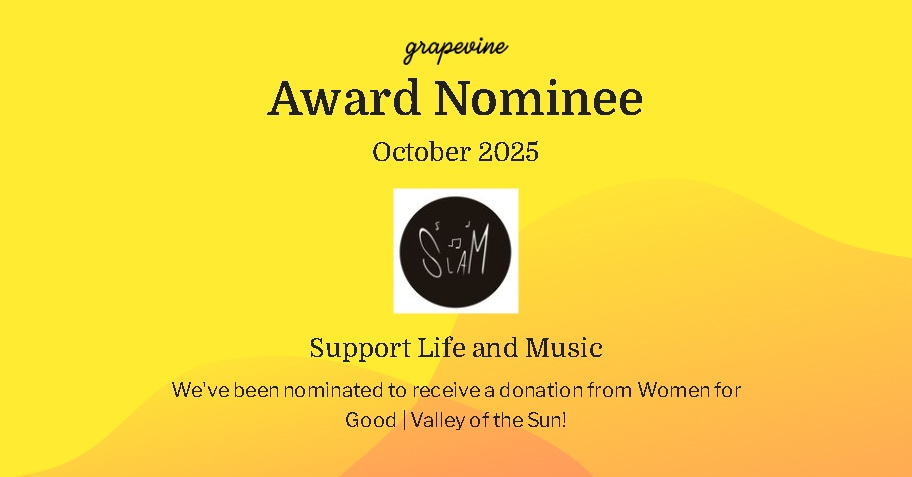
  • S.L.A.M. is nominated for a Grapevine Award!

    S.L.A.M. is nominated for a Grapevine Award!

    The wonderful Phoenix organization, Women For Good | Valley of the Sun, have seen fit to nominate Support Life And Music to be awarded a donation!

    We at S.L.A.M. are honored and grateful! We will:

    Continue working hard,

    Continue delivering on our promises,

    Continue improving S.L.A.M.’s services to live up to their belief – – and your belief – – in us.

    https://www.grapevine.org