
The definitive moment of Robyn Hitchcock’s second book, “Stranded in the Future,” occurs close to the end. During an episode that is either an hallucination or an inter-dimensional excursion, a mental projection of his manager, Mr. D., says, “And you’re a bit weird – – or you’re trying to be.”
Robyn agrees that, yes, yes he is.
Did I mention that it’s a non-fiction memoir?
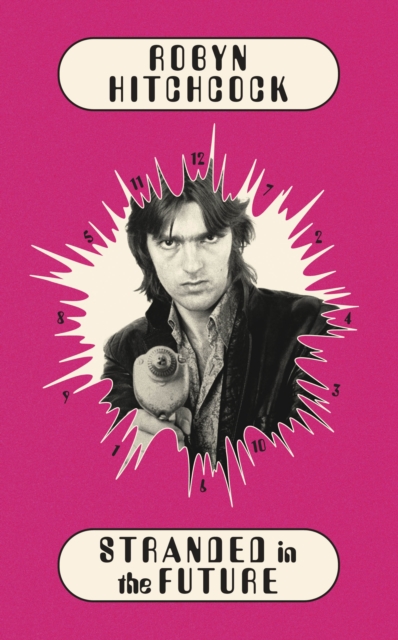
This book is many things, but at its outermost layer, it’s a fascinating ambling tour of Robyn’s life and obsessions in the 1970s. Some of them seem bafflingly strange and/or benign, while others are a bit more worrisome. The former would include his love of trains and his predilection for music, the latter his “pub compulsion and emotional distresses,” and his preoccupations with two specific people:
Mr. A/B, and Ms. C.
Mr. A/B is obviously Syd Barrett, founding member and the first frontman of Pink Floyd. He’s never called by his real name in the book, as if his image were being blurred out to protect his identity. No reason is ever given for the obfuscation. Hitchcock refers to Syd as Mr. A when he was at the top of his persona, style, and creativity, and then as Mr. B after his mental break, following his dismissal from Pink Floyd, during his spiral into worsening physical and mental health. As a minor spoiler, it’s significant that Robyn does not know him personally, he’s just a massive, obsessed fan.
He does know Ms. C. more intimately. She’s an old girlfriend who remains a presence in his mind and in his social circle, even when he moves in with his partner and their children. These two are more motifs than characters, but they appear again and again throughout the book.
Bios and autobiographies for musicians of this age typically start in young childhood memories, then proceed to talk about discovering Elvis or the Beatles or somesuch, before detailing failed early bands and gigs before the surge to stardom and mo money mo problem.
“Stranded in the Future” doesn’t bother much with that stuff.
Oh, there are a number of vignettes of his early bands and rehearsals. . . These ventures then lead him to his first well-known band, the Soft Boys. . . That narrative then ticks through their 15 minutes of fame, gaining notoriety as an eccentric late ‘70s English oddity, baffling both sides on the Punk vs. mainstream battlefield. But the music and the Soft Boys are only part of the story; not the crux. More than a VH1 chronicle of his ascent to fame, “Stranded in the Future” is a wandering, lyrical drift through this defining period of his life, meandering through thoughts and reactions to relationships and events in his early adulthood.
All novels and memoirs are monologues, of course, but this one evokes a sense of conversation, as if you’re sitting for a pint with Robyn, cigarettes smoldering in ashtrays on the table between you, low-volume music playing in the background, while he regales you with his stories.
What I’m saying is: don’t go to this book looking for detailed facts and historical notes about Robyn Hitchcock’s music and history. The nuggets are embedded here and there, I guess, but – – it just ain’t that kinda book. “Stranded in the Future” reads more like a character-focused novel, a plotless encapsulation of time like Catcher in the Rye, conveying events in our unreliable narrator’s life, along with his reactions to them. Hitchcock’s writing is personal, genuine, earnest, sincere, unhurried, self-conscious, and a little bit detached, if those elements can coexist without contradiction. He knows what he’s doing with prose; his style evokes Kurt Vonnegut, Julian Barnes, Nick Hornby, Steve Martin, Mariam Keyes, all with a Pythonian sense of the absurd.
It’s quite a feat to blend autobiography and fiction into one package. Sometimes surreal, sometimes disturbing, sometimes heartbreaking, sometimes laugh-out-loud funny, but always fascinating, always compelling. There are so, so many folded page corners in my copy of the book, for all of the great lines or paragraphs that I wanted to remember. Now that’s a telltale of skilled writing.

Robyn Hitchcock fans will embrace and enjoy every word of “Stranded in the Future,” but let’s be clear: many outsiders will not. There will be curled lips, arched brows, and puzzled expressions. This is not the new mainstream “Da Vinci Code”-esque bestseller sensation of 2026; he won’t be discussing it on television with Oprah. It’s an oddity by an odd person for odd people.
But hey – – I enjoyed “Stranded in the Future” immensely. What does that make me? His delivery and knack for clever phrases are a true pleasure to read. Any music lover, professional musician, or aspiring pro player can get a lot out of this, especially when he talks about the drugs, booze, record labels, management, fans, the clubs, and the encounters with other rockstars. Nick Lowe and Elvis Costello make a bunch of appearances – – with their full names! Mainly, it you can hang with the weirdness, it’s just a good read.
*Stranded in the Future” has a predecessor, by the way: “1967: How I Got There and Why I Never Left.” Full Disclosure: I’ve not read it. The dust jacket on “Stranded in the Future” lists the two books as sequential, but I never felt lost or as if I were missing essential details while reading this book. I think you’ll be OK if you start with this one.
~~~~~~~~~~